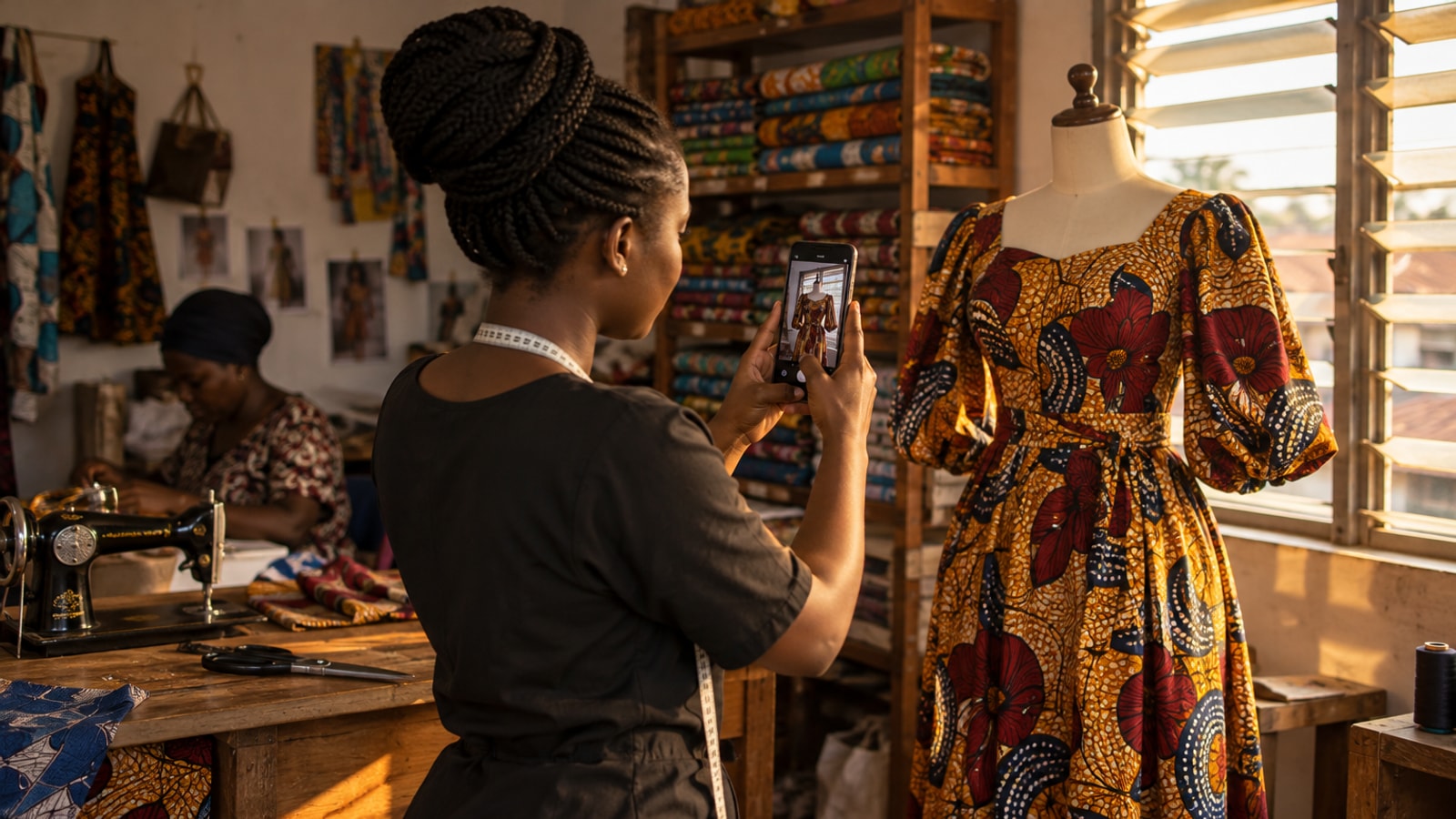
Efe runs a two-person tailoring shop off Sapele Road in Benin City. She films a short clip of every finished outfit, which is the right instinct, and she buys a ₦7,500 monthly bundle that stops working around the 19th. Her theory was that Instagram had started eating data. The duller truth was that she had uploaded the same 90-second video three times, because the first two attempts died at 80 per cent on a bad evening network.
Data is a real cost of social media management for a Nigerian business, and almost nobody measures it. Most owners argue about it from memory. The number is already on your phone, and it takes two minutes to find.
Your phone already knows what you spend
Open your settings before you change anything. On an iPhone, go to Settings, then Cellular, and scroll past the toggles to the list of apps with the data each one used since you last reset the statistics. On Android it is Settings, then Network and internet, then the data usage screen, which shows usage per app for the current billing month.
Write down the figure for the apps you post from. That single number settles most of the argument. If Instagram shows 1.2GB and TikTok shows 6GB, the problem is not posting, it is watching. If the app you post from is also the app you barely browse, then the uploads really are the cost and the rest of this is worth your time.
What a gigabyte costs now
In January 2025 the Nigerian Communications Commission approved a 50 per cent rise in call, SMS and data tariffs, and retail prices moved further than the headline number. BusinessDay found the average price of 1GB across MTN, Airtel, Glo and 9mobile went from ₦287.50 to about ₦475, a jump of roughly 65 per cent, and that national data traffic fell from a record 1 million terabytes in January to 893,054 terabytes in February as people rationed (BusinessDay).
Small operators felt it in the bundle rather than in the per-gigabyte rate. Condia reported that the ₦3,500 that used to buy 10GB on MTN barely covered 7GB afterwards, and that many small businesses now budget ₦5,000 to ₦10,000 a month just to stay online (Condia). Across the country the spending is enormous: TechCabal put Nigeria's data spend at ₦20.87 billion a day in 2025 (TechCabal).
So the arithmetic is simple once you have your own figure. Say your phone reports 4GB against Instagram last month. At about ₦475 a gigabyte, that is roughly ₦1,900 of your bundle spent inside one app. Now you can decide whether it is worth cutting.
Where the megabytes actually go
Watching is usually bigger than posting. Video you did not make, playing automatically while you look for ideas, is the largest line on most people's app usage, and it is the one owners never count as work.
The avoidable cost is the repeated upload. An upload that fails at 80 per cent still spent the data, and the app gives you no refund and no warning. Two dead attempts on one clip can cost more than the week's actual posting. This is why posting at 10pm, when your area is congested and you are tired enough to accept a retry, is the single most expensive habit in the list.
Then there are the settings. Instagram keeps its upload controls under Settings, then Data usage and media quality, where a high-quality upload option can be limited to Wi-Fi only. Turning it off on cellular makes your uploads smaller.
You will find articles quoting an exact megabyte figure for one Reel upload. I would not trust them. The ones I read disagreed with each other by a factor of five, several were published by companies selling eSIMs, and none tested on a Nigerian network. Your own usage screen is better evidence than any of those numbers.
What to change this week without buying anything
Shoot at 1080p instead of 4K. In your phone's camera settings, 4K at 60 frames is roughly four times the file of 1080p at 30, and no one scrolling a 6-inch screen can tell the difference in a clip of a dress spinning. This one change cuts the file before it ever reaches an app.
Upload once, on your best connection, at a time your network is not crawling. For Efe that meant mornings at the shop rather than nights at home, and the failed uploads mostly stopped.
Decide the caption before you open the app. Half of her repeated uploads were not network failures at all. She had posted, read it back, disliked the wording, deleted it and posted again. Writing the caption in your notes first costs nothing and removes a whole category of waste.
Treat the app as the last step rather than the workspace. Editing inside Instagram means re-rendering and re-sending the file every time you change your mind.
The honest limit of all this
At about ₦475 a gigabyte, cutting 4GB to 2GB saves you roughly ₦950 a month. That is one small top-up. It is real money and it is not a turnaround. If posting costs you ₦2,000 of data a month and brings in one ₦25,000 order, the data was never your problem and tightening it is a distraction.
What the repeated uploads really cost is the post that never went out. Efe lost the Tuesday clip entirely on one of those bad nights, and a lost post is worth far more than the megabytes that died with it. Fix the habit for that reason, not for the naira.
Data is also the wrong thing to blame if nobody is responding. No upload setting rescues a week of posts with nothing to say in them, and in that case what you put out matters more than how it got there.
Where a tool changes the shape of the problem
Scheduling moves the upload off your phone and off your evening. When you load a file into a scheduling tool from a browser, it goes up once and the publishing happens later from a server, so a weak network at 9pm does not cost you the post or a second copy of the file. Threadovo works that way, and because it writes the week's captions and generates the images and clips in the cloud, the heavy files are not being exported and re-sent from your phone for each platform.
That helps with the upload, not with the scrolling, and it is honest to say so. If you post twice a week and your data bill is ₦3,000, software priced from ₦39,000 a month is the wrong purchase and you should keep your money. It starts to pay when you are running several accounts, or when you are a creator posting daily across platforms and the exporting and re-uploading has become the actual job (pricing, for creators). There is a 14-day trial, so the cheapest way to find out is to run one real week through it and check your usage screen afterwards.
Questions people ask
How much data does it take to upload one Instagram Reel?
Nobody can give you an honest universal number, because it depends on the length of the clip, the resolution you recorded at and the upload quality setting in the app. The reliable way to find out is to note your Instagram data figure in your phone settings, upload one clip over mobile data, and check the figure again.
Does Instagram's data saver reduce the size of my uploads?
Data saver is described mainly in terms of what you load and watch, and guides disagree about whether it touches uploads at all. The setting that clearly affects uploads is the high-quality upload option under Data usage and media quality, which you can restrict to Wi-Fi.
Is it cheaper to post from a laptop than from my phone?
Only if the laptop is on a connection you are not metering as tightly, such as office Wi-Fi. The file size is the same. What a laptop genuinely changes is the failure rate, because a bigger screen and a steadier connection mean fewer abandoned uploads and fewer accidental reposts.
Does scheduling posts use my data?
You spend the data once, when you upload the file into the scheduling tool. The publishing at the scheduled time happens from the tool's servers, so your phone is not involved and does not need to be online.
Should I post photos instead of video to save data?
Only if photos suit what you sell. A good carousel costs a fraction of a clip in data, but reach on short video is usually higher, so cutting video to save a thousand naira a month can cost you more in orders than it saves.