Four kinds of post will fill a whole year. Most social media management advice hands you a list of 101 content ideas, which is why you have read three of those lists and still opened Instagram on Monday with nothing to say. The list is not the problem. Ideas do not arrive on a schedule and your business does, so what you need is material that refills itself every week, including the weeks you do not feel creative.
Sikirat runs a catering kitchen in Ilorin with two staff and a generator that decides how the day goes. She cooks small chops for parties and trays for offices, and every order comes through WhatsApp. For most of last year her posting went like this: six posts in one week after a big event, then nothing for a fortnight, then a photo of a flyer somebody designed for her, then nothing again. She was not lazy. She had run out of things she thought were worth posting.
The thing that empties your week is supply, not ideas
Three to five posts a week on one platform is where most people land. HeyOrca's 2026 survey of social media managers puts the common sweet spot at two to five posts a week per platform, with very little gained above that. Call it four.
Four a week is about two hundred posts a year, out of one business, with nobody employed to make them.
Two hundred is the number nobody says out loud, and it is why idea lists fail you. A list of 101 ideas covers six months if you use every one exactly once, and you will not, because forty of them do not apply to a catering kitchen in Ilorin.
Going quiet costs more than posting something ordinary
Buffer studied 52 million posts across 220,000 accounts over 26 weeks and found that accounts posting in 20 or more of those weeks saw roughly a 450 percent lift in engagement compared with accounts that posted in four weeks or fewer, in its state of engagement report. A separate look at 4.8 million channel-weeks from around 161,000 profiles found that a week with no posts pulls an account below its own normal growth rate, and that even one or two posts in a week beats the silence.
Take that as permission. A plain post on Tuesday is worth more than the excellent one you keep meaning to make.
Four kinds of post, and the material is already on your phone
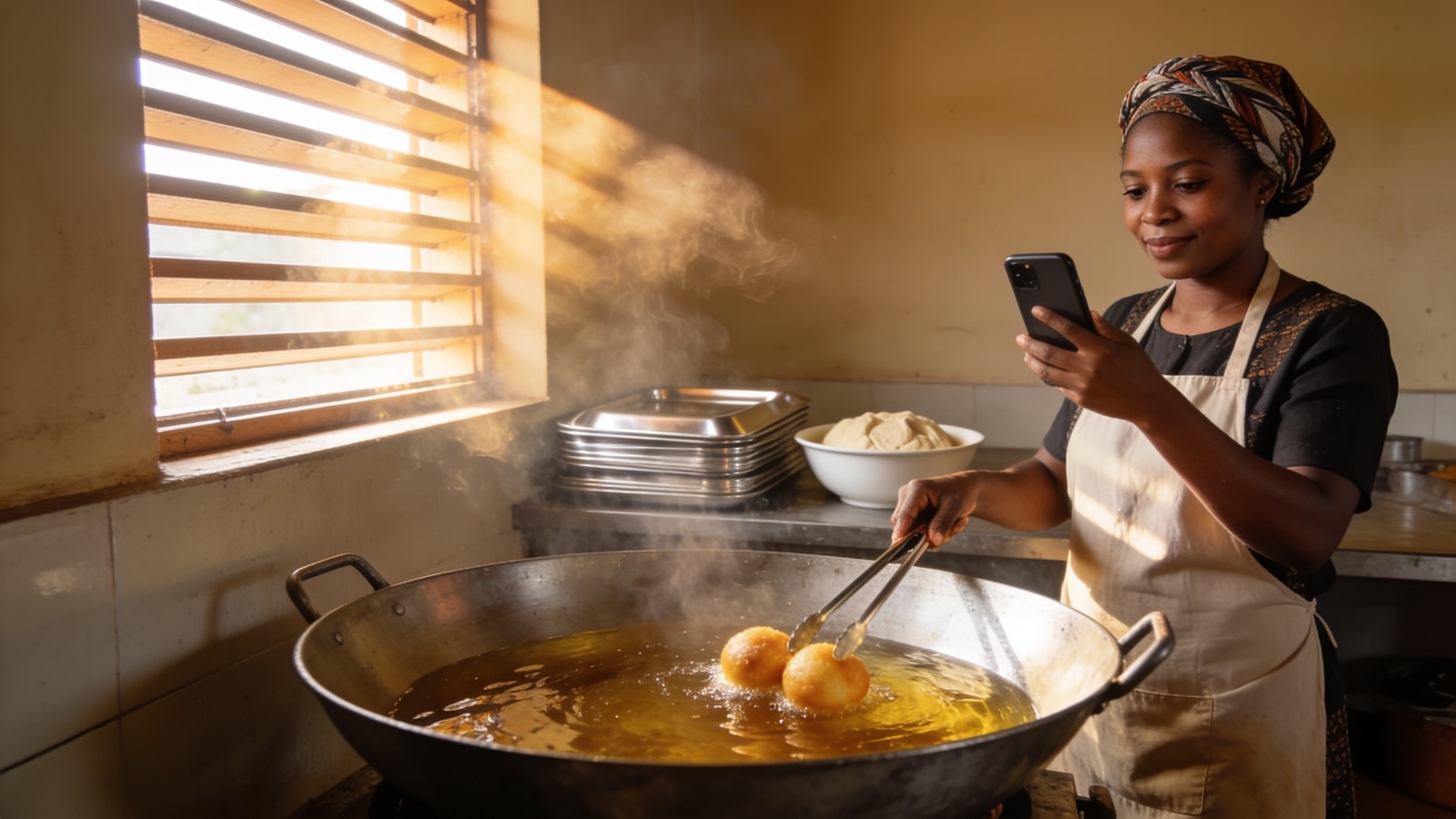
The first is the work itself. Not the finished plate styled on a marble board, the actual making: onions going into hot oil, the tray being packed, the delivery bike loading at 6am. Nobody outside the business has seen this and everybody is curious about it.
The second is the question you answered this week. If one customer asked it on WhatsApp, two hundred people wondered it silently. How far do you deliver. What is the minimum order. How much notice do you need for a hundred people. Each of those is a post, and you already wrote the answer once in a chat.
The third is price, said plainly. Most Nigerian small businesses hide price and then complain about time-wasters in the DMs. A post that says a fifty-person small chops tray is this much, delivery inside Ilorin included, filters out half the people who were never going to buy and gives the other half a reason to message you today.
The fourth is the person. Your face, your apprentice's name, why you started, the order that went wrong and what you did about it. This is the one owners resist hardest and the one that makes strangers trust a business they cannot walk into.
Each of those four refills on its own, for as long as the business runs.
A worked week from the Ilorin kitchen
Here is what Sikirat's week looks like now, which took her about ninety minutes on Sunday evening and some filming while she was already working.
- Monday: forty seconds of puff-puff going into oil, shot on the phone, no talking, caption saying she has three Saturday slots left this month.
- Wednesday: a screenshot of a real customer question about delivery to Offa, with her answer typed out underneath.
- Thursday: the price of the two most popular trays, written as text on a plain photo of the food.
- Saturday: her assistant Ridwan carrying trays into a hall, ten seconds, no caption beyond the venue and the headcount.
None of that is clever. It went out four times in a week, it took material from work that was happening anyway, and after two months her WhatsApp was getting messages from numbers she did not have saved.
Stop posting these
Motivational quotes on a coloured background with your logo in the corner. Nobody has ever bought jollof because of a Steve Jobs quote.
"Happy New Month" posts, unless you are actually saying something about the month. Reposted memes with nothing to do with what you sell. Flyers carrying six fonts and four phone numbers, which almost nobody reads to the end.
And graphics built from stock photos of food that is not your food. Customers can tell, and the day your real tray does not look like the picture, you have created a complaint.
When posting more is the wrong answer
If people are seeing your posts and not buying, more posts will not fix it. Two hundred views and no orders usually means the price is wrong for the audience you reached, the reply time is too slow, or nobody can tell what happens after they message you.
There is also a kind of business that does not need this at all. A canteen serving one office complex, a vulcaniser, a barber with a full chair from morning to evening. Their growth comes from location and referrals, and a posting schedule is a hobby they cannot afford.
Be honest about which one you are before you commit to two hundred posts.
Where software helps with this, and where it does not
The hard part of four posts a week is not creativity, it is the Tuesday when the generator dies and posting is the fifth thing on your list. That is the part a tool handles: planning the week in advance, writing the caption for each platform, making the image or the short clip, and publishing on the day so you do not have to remember. Threadovo does that work and holds each post for your approval before it goes out, and there is an Autopilot setting for owners who would rather approve a week at a time than a post at a time. It starts at ₦39,000 a month with a 14-day trial and no card, and the pricing page lists what each tier covers.
What no tool can do is film your kitchen. The proof posts, the ones that actually convert, need somebody in the room with a phone. Budget ten minutes a week for that. If you are a creator rather than a shop, the same four categories apply with your own craft as the work, on a slightly different rhythm.
Questions people ask
How many times a week should a small business post?
Three to five times a week on one platform is the working range, and consistency across months matters more than the exact number. Buffer's data shows a week with no posts at all costs you more than a week of ordinary ones, so four mediocre posts beat one perfect post and three empty days.
What do I post when nothing is happening in my business?
Answer a question a customer asked you this week, or show a routine part of the work you think is boring. The parts of your day you consider unremarkable are the parts nobody outside the business has ever seen, and they perform better than anything you would design.
Should I post the same thing on Instagram, TikTok and Facebook?
You can post the same footage, but the caption and the crop should change. A TikTok caption is short and sounds like speech, a Facebook one can carry the full details and the phone number, and Instagram sits between them.
Is it better to post daily or to post well?
For most small businesses, four times a week that you can keep up for a year beats daily for six weeks and then silence. Daily posting only pays off if you have a real supply of material, which usually means a business where the work itself is filmable every day.
Do I need a professional camera or a designer?
No. A recent phone shoots better video than most small businesses need, and posts that look handmade generally outperform polished graphics because they read as real. Spend money on lighting near where you work before you spend it on a camera.