Nobody at Instagram is going to cut your reach for making a post with AI. That is the short answer, and most of the pages ranking for this question stop there. The longer answer is the one that costs money. The platforms have drawn two specific lines this year, and neither is the one people worry about. The person most likely to punish you for an AI post is not an algorithm. It is the customer who is one bank transfer away from paying you. If you handle social media management for your own shop or for clients, there are two risks here, and only one of them has a settings toggle.
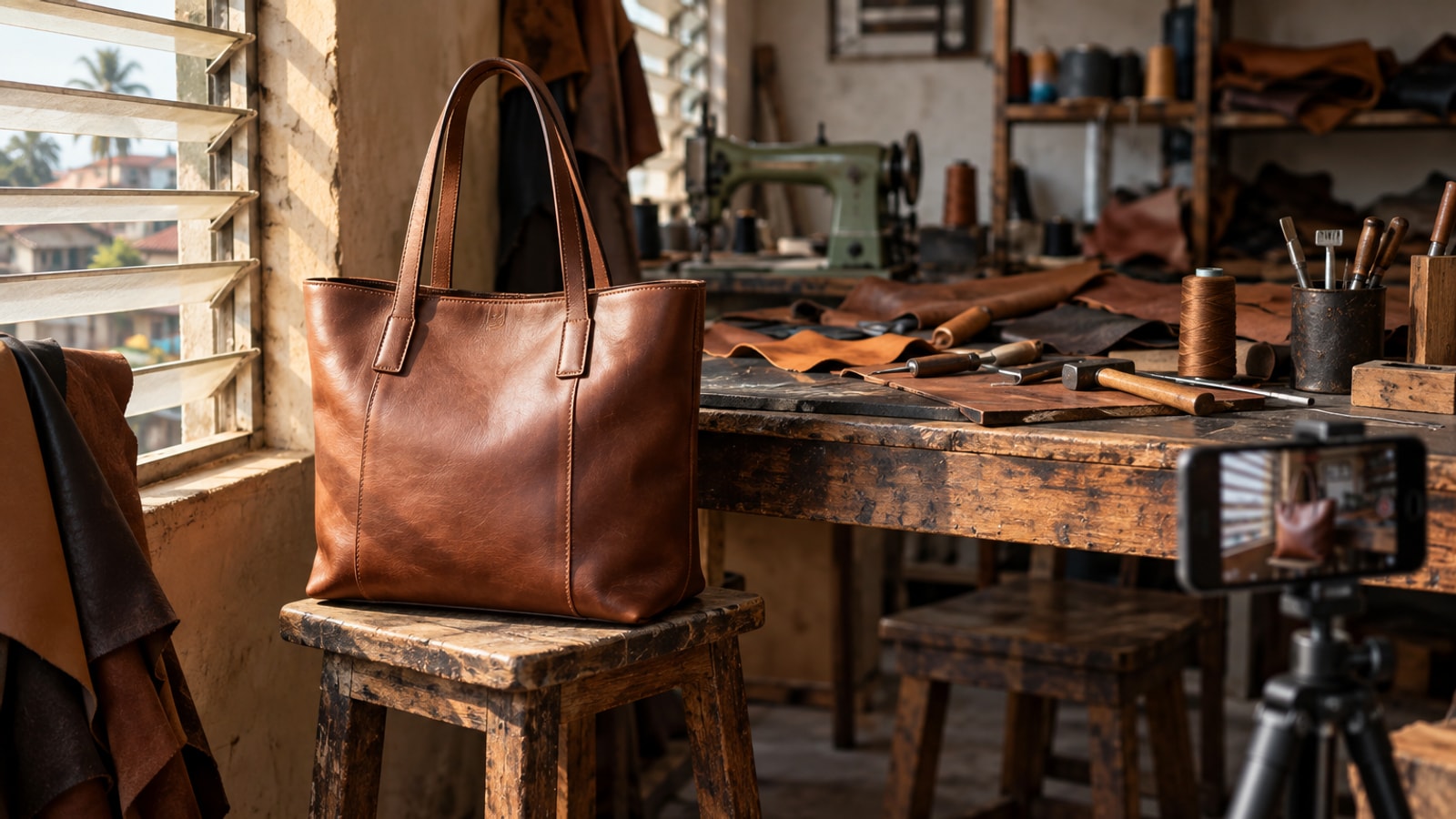
Chidera runs Nwanyi Leather, a six-year-old bag workshop off Faulks Road in Aba. Eleven thousand followers, almost every order closed in WhatsApp. In August she started generating her product images instead of shooting them: her tote on a pale marble table in soft morning light, a model holding it against a Lagos street at golden hour. The pictures were beautiful. Reach went up for about three weeks.
Then the messages started. "Is the brown this bright?" "Does it come with that gold buckle?" Two customers sent bags back. One posted her own photo next to Chidera's post, side by side, on her own page, with no caption at all. That single post cost more than the extra reach was worth.
Using AI tools to make posts does not get you demoted
Instagram's own rules draw the line at the profile, not the post. A real business owner who uses AI to retouch a photo, polish a caption or make graphics is explicitly outside the disclosure it now asks for, and profiles that do add its label see no change to their reach. Nothing in how posts get ranked was changed to look for AI. Saves and sends still decide what travels.
So the common fear is misplaced. If your reach fell in the same month you started using AI, the AI is probably not the reason. Reach moves for a dozen duller reasons, and there is a twenty-minute check for that which does not involve guessing.
The reach penalty is for an AI person you do not declare
This is the line most articles on the question skip. On 31 August 2026 Instagram renamed its "AI creator" label to "AI-generated profile" and said it would limit the reach of profiles that feature an AI-generated person without carrying that label. Unlabelled accounts of that kind stop being recommended to people who do not already follow them, in Reels and in Explore.
The scope is narrower than the headlines suggest. The label is for profiles where the person featured was generated or substantially created with AI. Chidera does not need it. An account built around a face that does not exist does, and if that is you, declaring it is cheaper than losing all your reach to strangers.
Reposting is the penalty people actually trip over
In April 2026 Instagram extended its original-content rule from Reels to the whole platform, photos and carousels included. Accounts that mostly post material they did not create, or did not meaningfully change, stop being recommended to people who do not already follow them. It runs on a rolling 30-day window. Crediting the original creator does not exempt you, and neither does a crop or a watermark.
This matters for AI work in one indirect way. The quickest way to fill a calendar is to pull someone else's viral clip, run it through a tool, and post it. That is the behaviour the rule is aimed at. Generating something from your own prompt and your own idea is not.
TikTok sits in a different place. It requires you to label realistic AI content, reads Content Credentials metadata, and has now labelled more than three billion videos as AI-generated using creator labels, that metadata, and an invisible watermark its own systems can read. Assume TikTok will work out what you made with AI whether or not you tell it. That is not a punishment, but it does mean the label is not really yours to withhold.
Your buyer is stricter than the algorithm
One number should change how you work. In Harris Poll research presented at Cannes this year, 73% of consumers said they would be less likely to trust an ad they suspected was made with AI, 78% said AI makes advertising feel less authentic, and 63% said they would be less likely to buy from a brand that uses AI-generated ads.
No platform is enforcing that. People are enforcing it on their own, in the comments and in your DMs, and in Nigeria where most of the sale happens inside a WhatsApp chat, they enforce it at exactly the wrong moment. A buyer about to send ₦45,000 looks at your picture one more time. If the bag in her hand later looks like a different bag, you have not lost reach. You have lost a customer and gained a review you cannot delete.
The rule that fixed it in Aba
Chidera's fix fits on one line, and it is the thing you can do today whatever software you use.
AI makes everything except the product.
Backgrounds, sale flyers, the Sunday text post, Reel covers, the carousel explaining how to oil leather: all generated, all fine. The bag itself gets photographed on the same wooden stool by the same window at about nine in the morning. The real photos look plainer than the generated ones did. Her returns went back to zero and the "is this the real colour" messages stopped.
That rule also survives a platform changing its mind, which is the part I would weigh most. These labelling rules have already moved twice this year. A habit of never showing a customer an object that does not exist never needs updating.
If you want the longer version: shoot your products once a month in one sitting, keep every shot in one folder, and generate everything around them. Four or five real photos of each item will carry a month of posts.
When AI images are the wrong answer entirely
Some businesses should not use generated product visuals at all. If the buyer is paying for the exact object in the picture, the gap between picture and object is your whole problem. Food, fabric, makeup shades, event decor, anything sold on colour. A generated plate of jollof will outperform your real one and then disappoint everyone it brings.
Software is also the wrong answer if your posting problem is that you have nothing to say. Tools make producing cheap. They do not make you interesting, and a faster pipeline for weak content just gets the weak content out sooner.
Threadovo generates images and short clips, writes captions per platform and plans the week, so it sits in the middle of this question. The part that helps with Chidera's rule is the other half: a content library to keep the real product photos in, and a human approval step before anything goes out, so a generated image never reaches a customer without someone looking at it first. What it does, what it costs in naira, and how creators use it differently from shops are all on the site. Which pictures are honest is still your call.
Questions people ask
Does Instagram reduce reach for AI-generated posts?
No. Instagram's disclosure rule is about profiles rather than posts, and profiles that add the label see no change to their reach. The reach limit applies to profiles featuring an AI-generated person that do not carry the "AI-generated profile" label, and separately to accounts that mostly repost other people's work.
Do I have to label my posts as AI?
On TikTok, yes, for realistic AI content, and the platform reads metadata and watermarks to catch what you leave out. On Instagram, post-level AI labels can be applied automatically and the profile-level label only applies when the person featured is AI-generated. If you use AI for graphics and captions, no profile label is needed.
Will customers know my product photo was made with AI?
Often, and they do not need proof to be put off. Harris Poll found 73% of consumers less likely to trust advertising they merely suspected was AI-made. The safer practice is to generate backgrounds and flyers but photograph the actual product.
Can I run a whole business account on AI content?
You can produce it, and nothing will stop you posting it. The limit is commercial rather than technical: if the content never shows the real thing you sell, your refund rate and your comments will tell you before any algorithm does.
Is it cheaper to generate images than to hire a photographer?
Per image, by a wide margin. A monthly shoot of your products plus generated everything else is usually the cheapest mix that still leaves the parcel looking like the picture.